Clinic Offers Expertise in Glomerular Diseases
In May 2024, 19-year-old Madison Lee came down with what seemed to be an ordinary, if obstinate, case of gastroenteritis—a stomach bug. At Malta Med Emergent Care, where she went for treatment for dehydration, a CT scan of her stomach showed she had colitis, an inflammation of her large intestine (the colon), which is common with gastroenteritis.
But there was more to her story: When she rapidly went downhill, she was admitted to Albany Medical Center, where she ended up being hospitalized for more than a month, including three weeks in the intensive care unit. While she had no known issues with her kidneys before then, they were suddenly failing.
Nearly ten years ago, in the winter of 2016, Vietnam veteran Charles Batchelor was vacationing in San Diego with his wife when he happened to stop at a health fair in Balboa Park, where he had his blood pressure taken. When it registered as extremely high, he was advised to see his primary care provider when he returned home. Around the same time, he also began experiencing migraine-like headaches; on the drive back to New York from California, he had uncomfortable swelling in both of his legs.
He later learned that his kidneys were malfunctioning.
Glomerular Diseases
Kidneys are vital organs that filter waste products, manage fluid and electrolyte balance, control blood pressure, and more. Each kidney has about one million nephrons, which help filter waste from the blood and produce urine. Each nephron includes a glomerulus, a network of small blood vessels that act as the first step when blood is filtered through the kidney.
Glomerular diseases—which Lee and Batchelor were each diagnosed with—occur when the glomeruli are damaged. When this happens, the kidneys have trouble or are unable to filter waste.
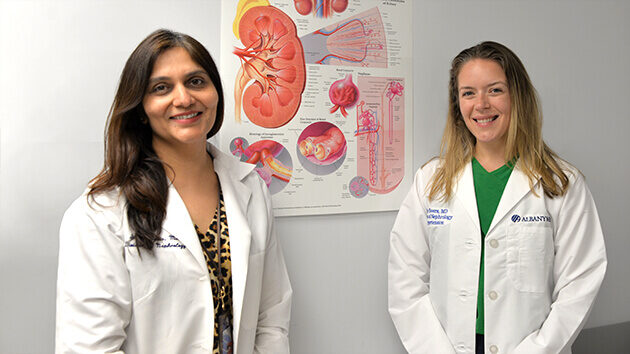
“Glomerular diseases encompass a wide range of conditions, take many shapes and forms, and occur in all types of people, and thus can be very complex,” said nephrologist Kelly Beers, DO, medical director of the Glomerular Disease Center at Albany Medical Center.
While relatively rare, some of the most common glomerular diseases include IgA nephropathy, lupus nephritis (SLE), and vasculitis. The gold standard for diagnosis is through a kidney biopsy, and many glomerular diseases can be treated with medication. Some require active management while others can go into remission, but if left untreated, they can lead to chronic kidney disease and kidney failure.
Nephrologist Swati Mehta, MD, co-director of the Glomerular Disease Center, added that without timely treatment, people with a glomerular disease may need to go on dialysis. “Many glomerular diseases are also systemic, in that they impact other organs in addition to the kidneys,” she said.
Life-Threatening Kidney Failure
Lee was diagnosed with hemolytic uremic syndrome, a rare, life-threatening condition in which part of the immune system becomes dysregulated, attacking healthy cells. This results in tiny blood clots throughout the body which can include major organs like the kidneys. Underlying genetic mutations or abnormalities in the immune system can predispose people to the condition, and it can be triggered by an infection.
“When Madi came into the hospital, she was very sick,” said Dr. Beers, who managed Lee’s care in the hospital and continues to see her in the outpatient clinic. “Her kidneys were shutting down.”
“They were pumping her full of fluids to try to kick start her kidneys. When that didn’t work, she was moved to the ICU where she was on 24-hour dialysis,” recalled Lee’s mother, Stacy Lee. “Madi doesn’t remember any of it,” she added.
Lee’s diagnosis was made from a triad of symptoms: Acute kidney injury, hemolytic anemia (characterized by the destruction of red blood cells), and thrombosis (blood clots in blood vessels).
Once they had a diagnosis, Dr. Beers and a team that included specialists in hematology and critical care worked together to treat Lee very quickly using an infusion drug that had been approved by the FDA just five years earlier.
“As an academic medical center, we’re able to access the latest treatments and medications that smaller hospitals don’t have,” said Dr. Beers. “Atypical hemolytic uremic syndrome used to be a death sentence. Madi could have died or she could have been on dialysis for the rest of her life. It’s wonderful to see the positive impact this treatment has had on her life.”
Stacy Lee agrees. More than a year after Madison was hospitalized, she’s doing “amazing,” said Stacy, who also credited Dr. Beers with saving her daughter’s life. To manage her disease, Lee now receives infusions at the hospital every eight weeks.
Managing a Chronic Disease
When Batchelor returned home from San Diego, he saw his primary care provider, followed by a series of other specialists, including a cardiologist, hematologist, and pulmonologist, as they worked to determine the cause of his symptoms. He was referred to Dr. Mehta when a blood and urine test revealed that the protein levels in his urine were very high.
After further tests, he was diagnosed with membranous nephropathy, an autoimmune condition where the immune system attacks the glomeruli, leading to kidney damage. The most common symptoms include fatigue, swelling, and proteinuria (excess protein in the urine).
Many glomerular diseases, like Batchelor’s, are due to inflammation and can be treated with specialized medications.
Though it took time to find the right combination of medicines that worked best for him, at a recent visit, Dr. Mehta noted that Batchelor’s protein levels are down significantly, adding, “The medications are working well and he’s in much better health.”
Batchelor still experiences swelling from time to time, but said his headaches never came back. He also manages his condition through diet, including fresh fruits, homemade foods, and alternatives to beef, like chicken, turkey, bison, and fish.
Exercise has also helped him stay healthy, and he and his wife, Susan, walk most days for about 45 minutes, usually at The Crossings at Colonie, where, Susan noted, “There are plenty of benches in case he needs to stop for a few minutes.”
Access to Additional Specialists, Latest Research
Led by fellowship-trained nephrologists who have additional certification in glomerular diseases, Albany Med’s Glomerular Disease Center includes specialists from rheumatology, pulmonology, hematology and oncology, and pediatric nephrology. The team also includes specialists in medical renal pathology (nephropathology) and a specialty pharmacist who is directly involved in patient care and counseling.
“Having this variety of experts was key to Madi’s diagnosis and recovery and sets us apart from other centers,” said Dr. Beers.
Clinical research is also becoming a crucial part of the Center as the clinic continues to grow. “We’re working to develop a biorepository of biopsy tissue, urine and plasma samples, and genetic data that can be used in future studies,” said Dr. Beers, who added that they are in talks to become involved in clinical trials in the future.
Albany Medical Center’s glomerular disease specialists see patients at locations in Albany, Latham, and Clifton Park. For more information or to schedule an appointment, call 518-262-5176.