Pilot Study Tests Isolation Gowns in Collaboration with College’s Business Incubator
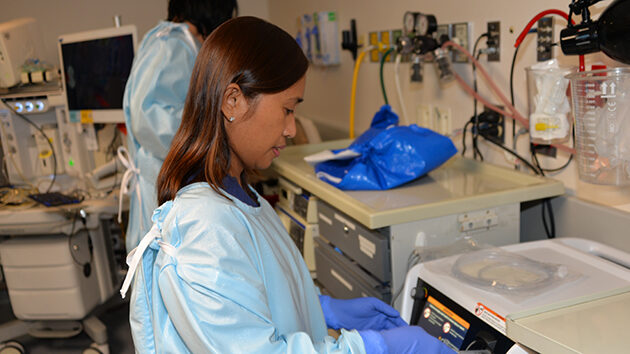
IsoGuardian, a Capital Region startup and affiliate member of the Office of Translational Research, Innovation, and Technology Transfer (OTR), recently achieved one of their major goals since joining the business incubator in 2024: A pilot study in a clinical setting for their washable, reusable isolation gowns.
Over the course of two weeks in December, Albany Medical Center clinical staff tested the gowns for varying lengths of time, in both inpatient and procedural outpatient units. This allowed IsoGuardian to gather critical feedback about the comfort, fit, and utility of the gowns in actual clinical use.
“We’ve had the privilege of mentoring IsoGuardian as they brought their isolation gown from concept to market, and we’re excited to celebrate this major milestone with them,” said OTR’s director, Stephanie Dosiek.
Bringing Biomedical Innovations to Market
As a bridge between research and industry, Albany Medical College’s OTR helps bring biomedical innovations like the IsoGuardian gowns from concept to market, connecting inventors with accelerators, funders, and partners.
Since partnering with OTR, IsoGuardian has registered with the FDA and its gown is now an FDA-registered Level 2 isolation gown available for purchase in the U.S. IsoGuardian has established a relationship with a large gown manufacturer capable of producing more than seven million gowns a month, and in 2024, IsoGuardian placed at Bioinnovation Bootcamp’s pitch competition, sponsored by Albany Medical College and Albany College of Pharmacy and Health Sciences, and FuzeHub’s 2024 Commercialization Competition.
“Our relationship with Albany Med has grown into a strong and highly productive partnership, marked by trust, collaboration, and a shared commitment to advancing safety for medical professionals,” Sara Rudin, founder of IsoGuardian, said.
Setting a New Standard for Hospital Isolation Gowns
Rudin notes that their aim is to provide a gown that focuses on safety, savings, and comfort.

Engineered for durability and performance, independent material testing that measures tear, burst, and hydrostatic pressure resistance has shown that IsoGuardian gowns are significantly more breathable and durable compared to other standard reusable isolation gowns. Rated for 300 industrial wash cycles, their cost per use is also lower than other comparable gowns.
During the pilot study, IsoGuardian’s team collected 116 daily surveys from users and 41 week-end surveys. The gowns received high marks on protectiveness, ease of use, and comfortability, with one user noting that the gown “feels more protective” and another praising it for being, “fully encompassing, covering more of me than other gowns.” Ninety-five percent of survey respondents felt safe in the gown, ninety-one percent felt it was easy to use, and eighty-five percent felt it was comfortable.
According to Rudin, the strong results of this pilot study signaled that the product is ready for adoption across a range of medical settings, including other hospitals.
Meanwhile, conversations are ongoing about the potential use of the gowns on a larger scale at Albany Medical Center, and the OTR is continuing to work closely with IsoGuardian to identify new opportunities as they introduce their product to a wider market.