New Logistics Center Enhances, Coordinates Patient Care
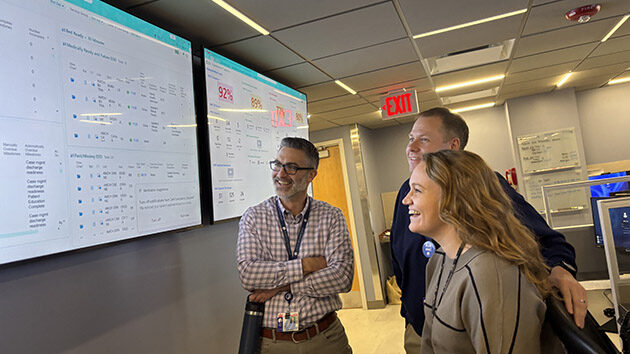
With four hospitals, 125 locations, a Level 1 Trauma Center, and children’s hospital, a team works behind the scenes at the Albany Med Health System to manage the complexity of coordinating care. From communication with regional first responders and providers, to internal transport and support staff, the new Capacity Command Logistics Center helps to ensure that the many parts of patient care throughout the System are moving efficiently when minutes matter most.
Overhead screens show how many patients are receiving care at all four campuses at any moment, right down to which departments are nearing capacity. Clinical and nonclinical experts monitor patient flow and work to move patients through the System so they can receive the care they need.
“This is traffic control for any patient who is coming in, transferring out, or in need of a bed,” said Ashley Telisky, DO, chief logistics officer. “Being together, in one room, this team can make decisions in real time to get patients to the right place at the right time for the right care.”
Building on best practices from command centers across the nation, Dr. Telisky worked with System leadership to remove silos and collocate specific disciplines to improve access. “When you’re within earshot to coordinate and brainstorm, you can come up with solutions faster. Our team now has the ability to look up and listen and make sophisticated decisions in real time based on the data at their fingertips,” said Dr. Telisky.
The logistics team works closely with colleagues throughout the System, with daily huddles to discuss opportunities to balance patient load. Epic, the System’s universal electronic medical record, enables a heightened ability to operate with visibility and transparency.
The Center also includes an emergency services dispatcher, the System’s first, to coordinate emergency medical care before a patient arrives at the hospital and help assess severity to determine the most appropriate setting for the patient.
“Each year, thousands of patients are transferred within the System to get the highly specialized care they need and then support to get back into the community, close to home for tertiary care and recovery,” said Scott Wies, RN, director of logistics clinical operations. Wies explained the continuous growth of this project over the last two decades. “Transfers continue to grow and this is the infrastructure to help coordinate care.”
For example, if a patient arrives at Glens Falls or Saratoga Hospital with a stroke, the logistics center quickly coordinates the transfer to Albany Medical Center, a Comprehensive Stroke Center. “We are able to get a stroke patient to the more advanced setting and then into their procedure suite within minutes, potentially minimizing the impact on the patient’s chance at recovery,” said Dr. Telisky.
Amanda Wing, MS, RN, director of logistics, nursing resources, and respiratory care at Glens Falls Hospital, said longtime collaboration between the hospitals has been strengthened by the combination of the enhanced logistics center and centralized patient medical records.
“We can see in black and white what is happening in the other hospitals, and accept patients when we have capacity,” she said. “We send our patients to Albany Medical Center for higher levels of care and are working on bringing them back sooner to be closer to home and open up capacity at Albany Medical Center—we see opportunities to help each other in real time.”
She noted the transitions are smoother as well, with care teams working from the same information.
“There is also the critical need for good customer service,” said Wies. “We are the warm voice on the other end helping to ensure that patients and providers alike are connected to all the levels of care when and where they are most needed.”