Albany Medical Center Leading Three Major Urological Clinical Trials
As an academic medical center, research is one of the core missions of Albany Medical Center. While basic scientists at Albany Medical College seek to understand diseases at the molecular level and translate those findings into better treatments, many Albany Medical Center clinicians are testing potential new therapies, procedures, or techniques to learn how to best manage and treat everything from heart disease to cancer.
Randomized clinical trials (also called randomized controlled trials) are the gold standard for evaluating the safety and effectiveness of potential new medical treatments, surgical interventions, or diagnostic procedures. In this type of study, participants are divided by chance into separate groups, allowing the investigators to analyze the results without bias.
“A large, randomized trial allows researchers to obtain the highest level of scientific evidence,” explained urologist Badar M. Mian, MD. “Compared to pharmaceutical trials, these investigator-initiated randomized trials are more challenging to conduct in that they can be resource- and labor-intensive, and require buy-in from key stakeholders, both within the System and at other centers nationwide and even around the world.”
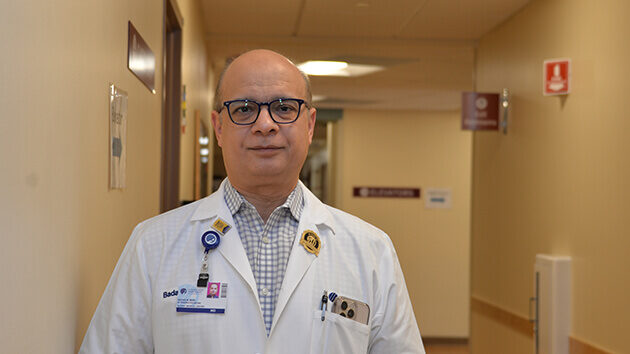
Dr. Mian, who specializes in diagnosing and treating cancers of the prostate, bladder, and kidney, is currently leading two national randomized clinical trials that were initiated at Albany Medical Center, and is continuing to analyze the results from a third, recently completed randomized trial.
“A well-conducted randomized clinical trial will yield tons of data that can be further explored to inform clinical practice and future research opportunities,” said Paul Feustel, PhD, director of the Office of Research Affairs at Albany Medical College, who, as a co-investigator on these studies, provides statistical and analytical support. “There have not been a lot of multi-center randomized clinical trials originating at Albany Medical Center,” he added.
Pros and Cons of Different Prostate Biopsy Techniques
Dr. Mian and his team have co-authored several articles, published in the Journal of Urology, that drew on the results of the recently completed ProBE-PC study, the first-ever randomized clinical trial to compare various prostate biopsy procedures.
The initial analysis showed that the risk of complications at Albany Medical Center after prostate biopsy—no matter which technique was used—were among the lowest in the country. A follow-up analysis of 840 men who participated in this randomized trial demonstrated that Albany Medical Center’s cancer detection rates were also among the highest reported nationwide.
The team subsequently analyzed the experience of the patients in the trial, based on their self-reported levels of pain, urinary function, and sexual function after their procedure. They found that the transperineal (skin puncture) approach, which is generally currently favored for prostate biopsy, was associated with more discomfort and urinary symptoms than the transrectal method. However, both procedures were associated with excellent patient experience and could be safely performed in the office setting.
“With nearly one million prostate biopsy procedures performed annually in the U.S., these cumulative results are critically important when counseling patients about the different prostate biopsy procedures and the trade-offs of each technique,” said Dr. Mian. “Ultimately, this is good news for our patients. This new information also fills a critical gap in clinicians’ knowledge and will be incorporated into future guidelines.”
Efficacy of Imaging Techniques for Prostate Cancer Detection
In the FOCUS-PC study (MRI-Targeted, Fusion or Cognitive Ultrasound Guided Biopsy to Detect Prostate Cancer), the investigators are examining the accuracy of different imaging techniques for targeted prostate biopsy to diagnose prostate cancer.
Suspicious prostate lesions that are seen on an MRI can be targeted for biopsy in one of two ways: By using the MRI scan alone, which may be faster, less expensive, and more readily available but perhaps less accurate, or by an image-fusion technique that uses a sophisticated, computerized platform to create a 3-D model of the prostate tumors. This may create a more accurate image, but it is more expensive, access to the technology is limited, and it is a longer procedure.
“It’s not clear if one approach is more accurate than the other in detecting and targeting prostate cancer since there haven’t been any randomized clinical trials to answer these questions, and as a result, the clinical guidelines on this topic are vague,” said Dr. Mian.
This first-of-its-kind large, randomized study began earlier this year, and the researchers hope to enroll more than 1,200 patients from multiple centers by the time the study concludes in two years. According to Dr. Mian, the study results will provide much needed information to clinicians and will help inform the guidelines regarding diagnostic accuracy, cost effectiveness, and access to care.
Reducing the Risk of Blood Clots and Bleeding After Abdominal Surgery
Another recently initiated randomized clinical trial is examining the interventions used to reduce the risk of bleeding or thrombosis (blood clots) after abdominal and pelvic surgery.
“Two of the major considerations after abdominal and pelvic surgery are the risks of bleeding and clots that travel to the lungs, causing a pulmonary embolism,” said Dr. Mian. He added that there aren’t clear clinical guidelines about using blood thinners in the peri- and post-operative settings because of the lack of high-level scientific evidence.
The ARTS study (Avoiding Risk of Thrombosis after Surgery) plans to enroll nearly 5,500 patients from six countries. Under Dr. Mian’s direction, more than 1,000 patients from eight centers in the U.S. who are scheduled for certain urological, colorectal, general, or gynecologic surgeries will be enrolled.
This study will aim to provide robust evidence regarding the benefits and harms of anticoagulation (blood thinners) before and after surgery.
“Once the study is complete, as the coordinating center, we’ll gather all the data and publish the results, with recommendations and guidance for surgeons on how to incorporate the results into their practice,” explained Dr. Mian. “Using the findings of studies like ours, the national guidelines committees will then make more global recommendations.”
Dr. Mian’s research team will be coordinating the participation of other centers in these two randomized trials, including Yale, Penn State, Roswell Park Comprehensive Cancer Center, University of Kansas, Lahey Clinic, Fox Chase Cancer Center, University of Manitoba, University of Toledo, and Montefiore Einstein in New York City.
“We are pleased that the success of our recent randomized studies has inspired clinicians at other centers to participate in our ongoing clinical trials,” said Dr. Mian.