NIH Funding Expands Research on Therapeutic Strategies for Nerve Disease
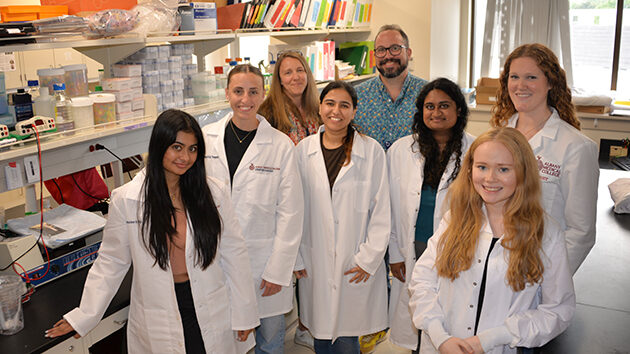
Two Albany Medical College scientists, Yannick Poitelon, PhD and Sophie Belin, PhD, have been awarded a five-year, $2.7 million grant from the National Institutes of Health’s National Institute of Neurological Disorders and Stroke to expand the framework of their research on Charcot-Marie-Tooth disease (CMT).
CMT is a group of inherited, progressive neuromuscular disorders that affect the peripheral nervous system (the nerves beyond the brain and spinal cord). Millions of people worldwide have been diagnosed with CMT, including approximately 150,000 in the U.S.
While the disease is present from birth, it progresses slowly, driven by a slow decline in the body’s ability to repair and regenerate nerves. Over time, this leads to worsening motor weakness, sensory loss, and gait impairment.
There is no cure, but treatments can help manage symptoms and maximize mobility.
Longtime Collaborators
Drs. Poitelon and Belin, associate professors in the Department of Neuroscience and Experimental Therapeutics, have been research collaborators since the early days of their undergraduate training.
As their individual expertise grew and they formed their own labs, their collaboration continued, integrating Dr. Poitelon’s knowledge of genetics, neuromuscular disorders, and the cell biology of myelinating cells with Dr. Belin’s understanding of the mechanisms of inherited demyelinating neuropathies and pharmacological approaches to treating them.
Their work has since evolved to focus on how myelin, a protective sheath that wraps around nerves, develops and how it’s impacted by genetic and acquired disorders. These diseases include multiple sclerosis, Guillain-Barré syndrome, and CMT, for which their research was recognized in 2025 with a prestigious grant from the Charcot-Marie-Tooth Association.
A Novel Approach to Treatment
CMT1A, the most common subtype of CMT, occurs when the PMP22 gene is duplicated. This leads to chronic overexpression of PMP22 protein which, in turn, causes sustained stress on Schwann cells (the cells that build myelin).
“With aging, the intrinsic capacity for Schwann cells to repair and maintain myelin further declines, accelerating nerve degeneration and limiting structural recovery,” said Dr. Poitelon.
TEAD inhibitors are a class of drugs that were developed to treat cancer and are currently in clinical trials. In previous studies, Drs. Poitelon and Belin showed that because they lower PMP22 levels, TEAD inhibitors may also be effective against CMT1A.
The NIH-funded study will expand their work to focus on the Hippo pathway, a signaling network that regulates cell proliferation. Using advanced genetic models and repurposed TEAD inhibitors, they’ll target a transcriptional complex within the Hippo pathway that regulates PMP22 expression in Schwann cells.
This will allow them to evaluate the potential of reducing PMP22 expression to alleviate CMT’s disease pathology and mitigate CMT1A-associated impairments. Then, in a preclinical mouse model, they’ll assess whether the TEAD inhibitors can prevent or reverse myelin defects and restore nerve function.
“By repurposing existing drugs and integrating pharmacological and genetic approaches, this tool compound study aims to provide a transformative strategy for CMT1A,” said Dr. Belin.
Hope for the Future
Finally, the team will perform comprehensive analyses and long-term safety evaluations to better understand the mechanisms of Schwann cells that underpin these interventions.
Their hope is that this type of Hippo pathway modulation will lead to the development of treatments for CMT1A that could also inform therapies for other inherited neuropathies that, like CMT, are characterized by disrupted myelin biology.
“There is a need for innovative treatment strategies for these debilitating diseases,” said Dr. Poitelon. “Our goal is to help accelerate the discovery of new therapeutic candidates and to improve outcomes for patients.”