Clinical Immersion Program Celebrates 10 Years
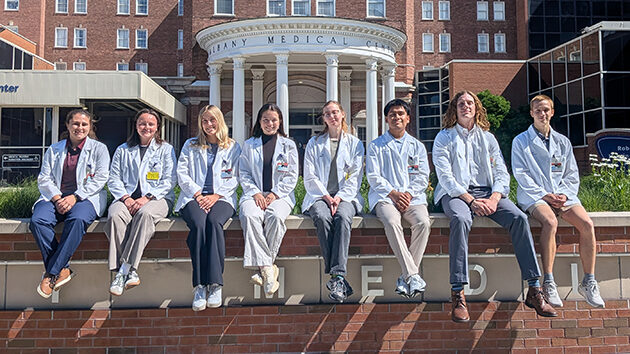
For the past decade, college engineering students have had a front-row seat to health care as it’s practiced in real life.
“Some of the best innovations begin with understanding a problem,” said Stephanie Dosiek, PhD, senior director of the Office of Translational Research, Innovation, and Technology Transfer (OTR), who has coordinated Albany Medical College’s Summer Clinical Immersion Program for many of its 10 years.
As part of the program, students from local colleges and universities, which have included Rensselaer Polytechnic University, Union College, University at Albany, and University at Buffalo, spend five to eight weeks embedded in clinical departments across Albany Medical Center.
“Students spend weeks observing care delivery,” Dr. Dosiek explained. “From that, they generate hundreds of observations that serve as the foundation for biomedical engineering capstone projects and future healthcare solutions.”
Identifying Clinical Needs
Rotating through different departments, the students shadow physicians and surgeons and interact with nurses and patients while actively looking for unmet clinical needs and health care innovation opportunities.
“The goal is to give engineering students first-hand exposure to medical devices and clinical workflows before they begin designing anything themselves,” explained Dr. Dosiek.
At the end of the program, the students return to their schools to design solutions to the clinical problems they identified, which in turn become their senior capstone engineering design projects.
From Clinical Observation to Commercialization
This year, eight biomedical engineering students from Union College rotated through 14 clinical departments and sites, including anesthesiology, the adult and pediatric Emergency Departments, dialysis, urology, gastroenterology/endoscopy, interventional cardiology, plastic & reconstructive surgery, and surgical oncology.
The students logged more than 400 clinical observations, which they organized and refined into 12 formal problem statements that were narrowed down to eight capstone design projects.
During the Fall 2026 term, the students will work in teams alongside their clinical mentors to design solutions to the challenges they identified. Then, during the Winter 2027 term, they’ll continue develop their projects into proof-of-concept ventures, culminating in a final engineering solution and presentation.
“Much like how OTR supports Albany Med Health System students, researchers, and clinicians in transforming their innovative biomedical ideas into commercialized technologies, the Clinical Immersion Program helps college students better understand how a clinical observation moves toward real-world translation and commercialization, connecting the classroom, the hospital floor, and the marketplace,” said Dr. Dosiek.
Capstone Projects
This year’s capstone projects drew from the students’ observations in the areas of anesthesiology, surgical oncology, pediatric emergency care, plastic surgery, and physical medicine and rehabilitation.
After seeing how anesthesiologists use a combination of blankets, towels, and pillows to support a patient’s head and neck to maintain a safe airway during surgery, one team is working to develop a more standardized solution that could be used with patients with different body types and clinical needs.
Another team noticed that the containers currently used to measure blood loss during surgery cannot distinguish blood from other fluids, and is investigating new designs for more accurate measurement tools.
After observing that during bilateral breast reconstruction surgery alignment is assessed visually or with informal measurements, a third team will work to develop technologies that could provide more objective and reproducible assessments during surgery.
Other teams will seek to develop new designs for syringes used during epidural procedures and nebulizers used to give respiratory medications to pediatric patients, while others will consider the specimen retrieval bags used in minimally invasive cancer surgeries, compression garments used after breast reconstruction surgery, and hand strength rehabilitation tools.
“As we celebrate the tenth year of the Clinical Immersion Program, we’re incredibly grateful to the clinicians and departments who have welcomed students into their workspaces year after year,” said Dr. Dosiek. “Their willingness to teach, answer questions, and share their experiences is what makes the program so impactful.”