Weight Loss Options - Saratoga Hospital
The road to health is paved with many options. Surgery is not for everyone, but healthy living is! We offer surgical and nonsurgical options for patients who are looking to begin their weight loss journey.
Surgical Options
Bariatric surgeries are medical procedures designed to help individuals lose weight when other methods have not been successful. It is typically recommended for people with a body mass index (BMI) of 35 or higher, or those with a BMI of 30 or higher who also have obesity-related health conditions.
There are several types of bariatric surgeries, each with its own benefits and considerations. At Saratoga Bariatric Surgery and Weight Loss Program, we perform the Roux en Y Gastric Bypass, Vertical Sleeve Gastrectomy and Revisional Bariatric surgeries for patients who have previously had surgery and are looking for further benefits including managing weight related conditions and further weight loss. Based on your medical history, Dr. Baranov will recommend your best option at your initial consultation.
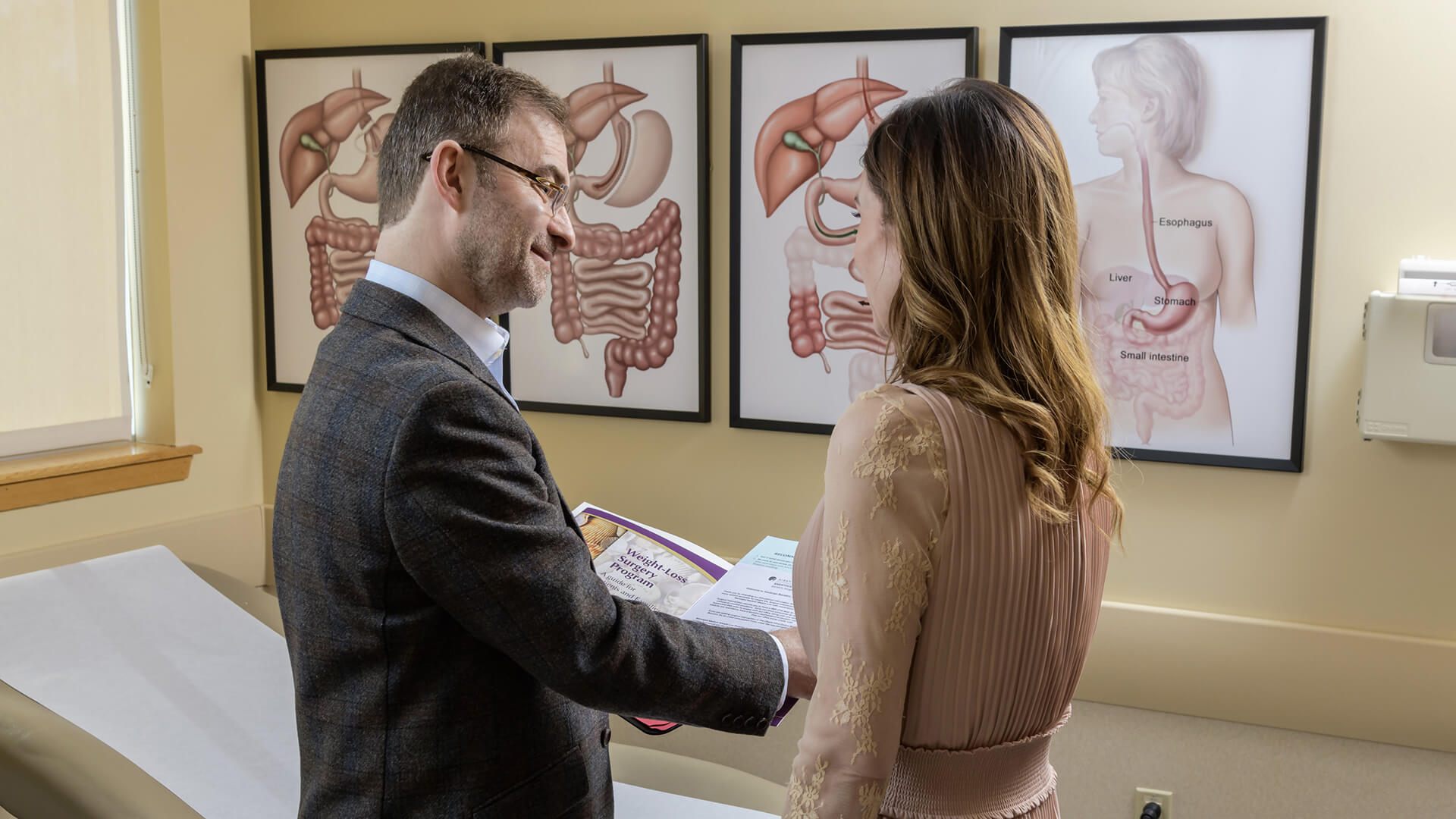
The gastric bypass is the gold standard of bariatric operations. The procedure allows the patient to feel satisfied, like they would have eaten a large meal, with only consuming small portions. During this operation, the bariatric surgeon will construct a new, smaller stomach, called the “pouch.” This is new, small stomach is made from your original stomach. Your small intestine will then be connected to the pouch, allowing it to empty after ‘bypassing’ the rest of the stomach and first part of the small intestine. The job of the pouch is to allow you to feel full when you have only eaten a small portion.
When the pouch is first made, it will hold about one ounce of food. An ounce is far less than what an original stomach would have fit, as the size of a normal human stomach is over one quart, or 32 ounces. After the bypass operation, a patient who used to be able to eat very large meals will realize they have much less room for food and the patient will feel full eating a much smaller amount of food. This operation works by making you feel full through eating smaller portions, leading to a decreased amount consumed and therefore, successful weight loss. With the bypass operation, there is malabsorption of vitamins and minerals, which is why it is required that you take your bariatric vitamins every day. There is not much malabsorption associated with the foods that you eat, but since you are eating less of them, your vitamin and mineral intake is not adequate, and you will need to take your vitamins every day.
There is more weight loss associated with the gastric bypass than the sleeve gastrectomy. Most patients will hit their maximum weight loss around 18 months after the surgery, before finding a weight which is usually around 70% of their excess weight loss.
The gastric bypass operation has been performed for more than 50 years, and it has been performed laparoscopically for the last 30 years. Patients are usually in the hospital for one night after the surgery and go home the next day.
Sleeve gastrectomy is the most common restrictive bariatric surgery performed in the United States. It is performed laparoscopically and takes around 30-60 minutes. This operation is performed by removing part of the stomach, leaving the patient with a narrow tube, or “sleeve” of stomach. This is just enough to connect the esophagus to the small intestine. The narrow tube, or “sleeve” cannot fit as much food as the old stomach did. As with the gastric bypass, the patient will feel fuller with smaller quantities of food, which will allow them to eat less and lose weight. The sleeve does not involve the small intestine, which is why it can be a great option for patients with small intestinal diseases (like IBS, IBD or other conditions).
Just like with the gastric bypass, you will require daily vitamin supplements to provide your body with the right vitamins and minerals that you are missing due to a decrease in food intake. Patients are usually in the hospital for one night after the surgery and go home the next day.
Weight loss with gastric sleeve surgery is around 60-65% excess weight loss, which is just shy of that expected with the gastric bypass. If a patient decided their weight loss after gastric sleeve surgery is not enough, other operations can be considered in the future to provide further weight loss.
Revision of adjustable gastric banding to Vertical Sleeve Gastrectomy or Roux en Y Gastric Bypass:
- Patients who experience weight regain, complications or significant side effects from previous adjustable gastric banding (AGB), also known as “lap band”, procedures may be able to have their band removed and a sleeve or bypass performed during the same operation. At your initial consultation, Dr. Baranov and his team will make this recommendation if it is a possibility for you.
Revision of Vertical Sleeve Gastrectomy or Roux en Y Gastric Bypass:
- Some patients who have previously had sleeve gastrectomy do have the option for their sleeve to be created into a pouch and perform the bypass operation from their previous sleeve. At your initial consultation, Dr. Baranov and his team will make this recommendation if it is a possibility for you.
Do you qualify for weight loss surgery?
Current guidelines from ASMBS recommend that patients with a BMI above 35 without weight related comorbidities and patients with a BMI above 30 with weight related comorbidities undergo bariatric surgery to improve quality of life and medical conditions. Weight related comorbidities include type 2 diabetes, elevated blood pressure, elevated cholesterol, obstructive sleep apnea and non-alcoholic fatty liver disease. Saratoga Hospital is recognized as a center of distinction by major insurance companies in our area.
Our pre-operative and post-operative processes are rigorous and comprehensive due to requirements mandated by insurance companies; we are here to help you navigate this process.
Register For a Seminar!
(choose "bariatrics" in the menu)
Non-Surgical Options
If you do not meet requirements for weight loss surgery, or, you are not ready to commit to the surgical approach, there are other options. We offer a variety of non-surgical weight loss options including the latest and most effective weight loss medications which incorporates one-on-one nutrition counseling alongside registered dietitians.
The intragastric balloon has been developed as a non-surgical alternative for those who have been unsuccessful trying to lose weight. At your individual consultation, Dr. Baranov will ask you about your medical history and conduct a physical examination to determine if this procedure will be an option for you.
The first step of this two-part, 12-month program, begins with balloon placement into the stomach guided by endoscopy. A thin, deflated balloon is placed into the stomach and then filled with saline until it’s about the size of a grapefruit. The procedure normally takes about 20-30 minutes and people go home the same day.
The balloon remains in your stomach for six months and helps create habits like healthy eating and portion control by assisting you to feel full off smaller amounts of food. Our team will support you in learning new eating habits and lifestyle changes for long-term success.
The second step begins once the balloon is removed. The balloon is removed after six months. To be successful you will have to sustain the new habits you made while the balloon was in place.
You will be required to follow a six-month diet and exercise plan after the balloon is removed. Our team will help you reach your weight loss goals by retraining your appetite, advising on healthy nutritional choices, controlling portion sizes, and developing an exercise routine. Adopting and maintaining these healthy habits will ensure that you succeed.
Results vary, but patients lose around three times the weight with this procedure as patients that maintained diet and exercise plans alone.
In the first few days after the balloon has been placed, you may experience nausea or vomiting. In some patients this may last longer. We will work with you and prescribe medication that will help manage these symptoms and help you adjust to the balloon.
The stomach balloon procedure is considered a safe and effective weight loss solution, with over 220,000 placements worldwide. Complications that may result include standard risks associated with any endoscopic procedure. More information is available during your initial consultation with Dr. Baranov.
Our program offers many FDA-approved weight loss medications which can be effective when paired with the right lifestyle and dietary modifications needed for successful weight loss.
There are qualifications that are set by your insurance company in order to be prescribed these medications. If you qualify, we will work with you to find the right medication or combination of medications to assist with weight loss. If your insurance does not cover weight loss medications, we can work with you to find more affordable options depending on your health conditions. Medications are prescribed at your provider's discretion and are intended to help you become healthier as a person. Our highly trained team will evaluate you and your current conditions and decide which medication is right for you.
Our registered dietitians have extensive training in a variety of techniques to support patients in making lifelong changes to improve their health. As a patient at Saratoga Bariatric Surgery and Weight Loss Program, it is required that you meet with our nutrition services to support your journey and meet insurance requirements for the medications you may be prescribed.
Our dietitians will work with you to develop a personalized lifestyle plan for you to meet your goals. Each patient’s plan is based off scientific research and proven strategies to ensure safety and success. We will work with you to provide practical options to make sure you are successful despite your busy schedule and providing for your family. We encourage you to take advantage of our dietitian's knowledge as they are available to provide lifelong, nonjudgmental support and motivation that can make all the difference in your weight loss journey.
Body Composition Analysis
Body composition, or fat versus fat-free (lean) mass, has long been considered one of the best determinants of a person's overall health. It is also a useful tool used in disease prediction. It can show a visual representation of your nutritional practices and physical activity as body weight alone is misleading.
Our non-invasive assessment is performed on a medical-grade body composition analysis scale that provides and in-depth evaluation that is more accurate than a bone density test. It will measure your fat vs fat free mass, hydration status, nutrition status and much more. The scale takes just under 20 seconds, and then you will be able to review your results with a dietitian and your recommendations will be based off your results. This is another way we individualize weight loss treatment at our program. You will be provided with a copy of the report. Additionally, this machine will be used to track progress and make even more dietary and lifestyle changes as you meet your goals.